Quantum Computing Explained: A Beginner's Guide
quantum computing explained

Quantum Computing Explained: A Beginner's Guide

Unlock the mysteries of quantum mechanics and discover how this revolutionary technology is poised to transform our world.

Start Your Quantum Journey

Key Takeaways

  • ✓ Quantum computers use qubits instead of bits, allowing for superposition and entanglement.
  • ✓ Superposition means a qubit can be both 0 and 1 simultaneously.
  • ✓ Entanglement links qubits, so the state of one instantly affects the other, regardless of distance.
  • ✓ Quantum computing excels at solving certain complex problems intractable for classical computers.

How It Works

1
Qubits: The Quantum Bit

Unlike classical bits (0 or 1), qubits can exist in a superposition of both states at once. This fundamental difference unlocks immense processing power.

2
Superposition: Being in Two Places

Imagine a coin spinning in the air; it's neither heads nor tails until it lands. A qubit in superposition is similar, representing multiple possibilities simultaneously.

3
Entanglement: Spooky Action at a Distance

When qubits are entangled, they become interconnected. Measuring one instantly affects the other, even if they are physically separated, enabling complex calculations.

4
Quantum Gates: Manipulating Qubits

Quantum gates are the building blocks of quantum circuits, performing operations on qubits. These gates manipulate superposition and entanglement to solve problems.

Demystifying Quantum Mechanics for Computing
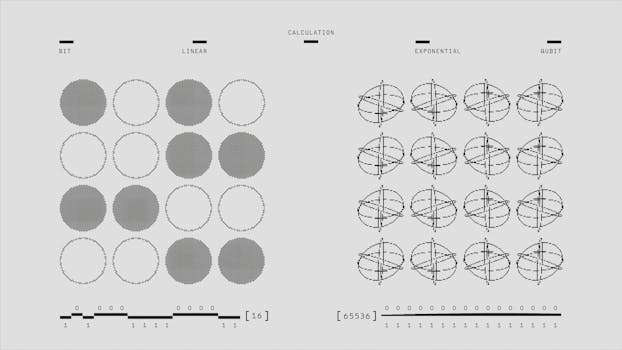
Visual representation of geometric calculations comparing bits and qubits in black and white. Photo: Google DeepMind / Pexels
To truly explain quantum computing for beginners, we must first gently step into the bizarre world of quantum mechanics. Forget everything you know about how the world works at a macroscopic level, because down at the atomic and subatomic scales, reality operates by a different set of rules. The two primary phenomena that underpin quantum computing are superposition and entanglement. Superposition allows a quantum particle, like an electron or photon, to exist in multiple states simultaneously. Think of a classical bit as a light switch that is either ON (1) or OFF (0). A quantum bit, or qubit, is like a dimmer switch that can be ON, OFF, or any intensity in between, and even all intensities at once until observed. This isn't just a metaphor; it's a fundamental property that gives quantum computers their immense parallel processing capability. If you have two classical bits, they can be in one of four states (00, 01, 10, 11) at any given time. With two qubits, thanks to superposition, they can effectively represent all four states simultaneously. This exponential increase in representational power is what makes quantum computing so revolutionary. As you add more qubits, the number of simultaneous states grows exponentially (2^n where n is the number of qubits), far outstripping the capabilities of even the most powerful supercomputers. Understanding the basics of quantum mechanics is crucial for grasping why quantum computing is such a paradigm shift. Entanglement is even stranger. When two or more qubits become entangled, they form a deeply interconnected system. The state of one entangled qubit instantaneously influences the state of the others, no matter how far apart they are. Albert Einstein famously called this phenomenon "spooky action at a distance." This interconnectedness means that measuring the state of one entangled qubit immediately tells you something about the state of its entangled partners, without needing to measure them directly. This property is harnessed in quantum algorithms to create highly efficient computational shortcuts, allowing quantum computers to explore vast numbers of possibilities simultaneously and identify correct solutions much faster than classical methods. These two concepts—superposition and entanglement—are the bedrock upon which all quantum computational power is built, differentiating it fundamentally from classical computing.

The Building Blocks: Qubits vs. Classical Bits
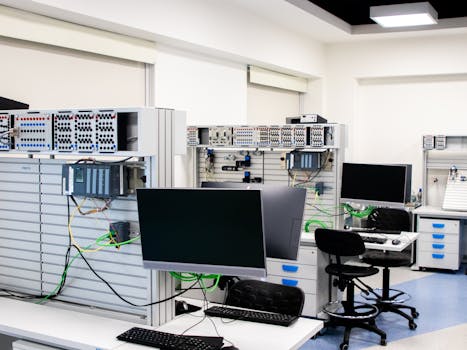
A contemporary computer lab with advanced workstations and electronic equipment, perfect for research and development. Photo: Ludovic Delot / Pexels
The fundamental difference between classical computers and quantum computers lies in their basic unit of information: the bit versus the qubit. A classical bit, as we know, can only represent one of two states at any given moment: 0 or 1. This binary system forms the language of all classical computing, from your smartphone to the largest data centers. Every piece of information, every instruction, every pixel on your screen is ultimately encoded in sequences of 0s and 1s. This straightforward, definite state is easy to understand and implement with electrical signals, transistors, or magnetic polarities. However, it also imposes limits on how many calculations can be performed in parallel and how efficiently certain complex problems can be tackled. To explain quantum computing for beginners, it’s vital to highlight how qubits transcend these limitations. A qubit, or quantum bit, leverages the principles of quantum mechanics to exist in a state of superposition. This means a single qubit can represent 0, 1, or a combination of both 0 and 1 simultaneously. It's not just a fuzzy middle ground; it's literally holding the potential for both outcomes until measured. This unique capability is not merely an improvement but a complete re-imagining of how information can be stored and processed. Imagine a single qubit as having access to two dimensions of information simultaneously, rather than just one. When you have multiple qubits, the complexity grows exponentially. For instance, two classical bits can store one of four possible values (00, 01, 10, 11) at any given time. Two qubits in superposition, however, can effectively represent all four of those values simultaneously. This exponential scaling is where the true power of quantum computing lies. With just 300 qubits, a quantum computer could store more information than there are atoms in the observable universe, a feat utterly impossible for any classical machine. This ability to explore multiple computational paths simultaneously is what allows quantum algorithms to solve certain types of problems that are intractable for even the most powerful supercomputers. The physical realization of qubits is also vastly different. While classical bits rely on voltage levels in transistors, qubits are often implemented using exotic quantum phenomena in superconducting circuits, trapped ions, or photons, requiring extreme cold or precise laser control. These physical distinctions highlight the engineering challenges and the profound scientific advancements required to build and operate quantum computers, making them a marvel of modern physics and engineering.

Applications and the Future of Quantum Computing
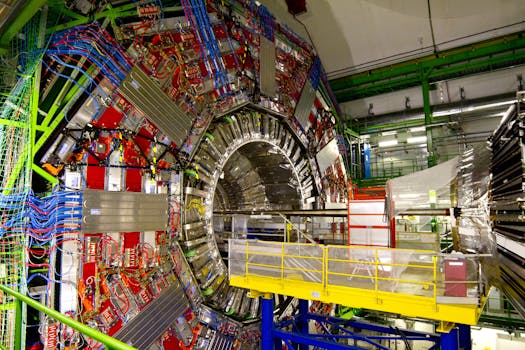
A close-up view inside CERN's Large Hadron Collider in Geneva, Switzerland. Photo: Ramaz Bluashvili / Pexels
The promise of quantum computing extends across numerous fields, offering solutions to problems currently considered impossible for classical computers. One of the most talked-about applications is in drug discovery and materials science. Simulating molecular interactions with classical computers is incredibly complex, as the number of possible interactions grows exponentially with the size of the molecule. Quantum computers, with their ability to model quantum phenomena directly, could accurately simulate molecular structures and chemical reactions, leading to the development of new drugs, more efficient catalysts, and novel materials with unprecedented properties. Imagine designing a perfectly tailored drug for a specific disease or creating a superconductor that works at room temperature – these could become realities with quantum technology. Another significant application is in cryptography. Shor's algorithm, a quantum algorithm, theoretically allows quantum computers to factor large numbers exponentially faster than classical computers. This poses a serious threat to current public-key encryption standards, which rely on the difficulty of factoring large numbers for their security. While this is a concern, it also drives the development of quantum-resistant cryptography, ensuring secure communications in a quantum future. Financial modeling is another area ripe for quantum disruption. Quantum computers could optimize complex financial models, predict market fluctuations with greater accuracy, and manage investment portfolios more effectively by processing vast datasets and evaluating intricate scenarios. This could lead to more stable and efficient financial markets. Machine learning and artificial intelligence also stand to benefit immensely. Quantum machine learning algorithms could process and analyze data in ways currently unimaginable, leading to more powerful AI, better pattern recognition, and advancements in fields like image recognition and natural language processing. Imagine AI that can learn from sparse data or identify subtle trends hidden within massive datasets, revolutionizing everything from medical diagnostics to personalized recommendations. Furthermore, quantum computers could optimize complex logistics and supply chain management, finding the most efficient routes and schedules for global transportation networks, reducing costs, and minimizing environmental impact. The implications for industries like automotive, aviation, and shipping are profound. While widespread commercial quantum computers are still some years away, the rapid advancements in research and development suggest that a quantum-powered future is not a matter of if, but when. Exploring the ethical implications of advanced AI is also a crucial discussion as these technologies develop. These diverse applications underscore the transformative potential of quantum computing, promising to reshape our world in ways we are just beginning to comprehend.

Challenges and Misconceptions for Beginners

While the potential of quantum computing is immense, it's crucial for beginners to understand the significant challenges and common misconceptions surrounding this nascent technology. Firstly, quantum computers are not simply faster versions of classical computers for all tasks. They excel at specific types of problems that leverage superposition and entanglement, such as optimization, simulation, and factoring, but they won't replace your laptop for browsing the internet or playing video games. They are specialized tools for highly complex computational tasks. **Common Challenges:** * **Decoherence:** Qubits are extremely fragile. They lose their quantum properties (superposition and entanglement) very easily due to interaction with their environment, a phenomenon called decoherence. This requires qubits to be kept in extremely cold temperatures (near absolute zero) or isolated in a vacuum, making them difficult to maintain and scale. * **Error Correction:** Due to decoherence and other noise, qubits are prone to errors. Developing robust quantum error correction techniques is a major hurdle, as classical error correction methods don't directly apply. * **Scalability:** Building quantum computers with a large number of stable, interconnected qubits is incredibly difficult. Current machines have dozens or hundreds of qubits, but thousands or millions are needed for truly transformative applications. * **Programming:** Programming quantum computers requires a different mindset and specialized algorithms. It's not like writing code for a classical computer; it involves understanding quantum gates and circuits. **Common Misconceptions:** * **Quantum computers will make classical computers obsolete:** Not true. Classical computers will remain essential for most everyday tasks. Quantum computers are designed to complement, not replace, classical computing for specific, hard problems. * **Quantum computers are infinitely fast:** Also not true. They can solve certain problems exponentially faster, but they still take time, and their speed advantage is problem-dependent. * **Quantum computers can solve any problem:** While powerful, they are not a universal panacea. There are many problems where classical computers remain more efficient. * **Quantum computing is science fiction:** It's very real! Working prototypes exist today in research labs and companies worldwide, demonstrating the fundamental principles and solving small-scale problems. The field is rapidly advancing, moving from theoretical possibility to practical implementation. Understanding these nuances helps set realistic expectations about the current state and future trajectory of quantum computing.

Comparison

FeatureClassical ComputersQuantum ComputersKey Difference
Basic UnitBit (0 or 1)Qubit (0, 1, or both simultaneously)Superposition
Information StorageLinear statesExponential states (2^n)Parallel processing potential
Core PrinciplesBoolean logic, transistorsSuperposition, EntanglementQuantum mechanics
Problem SolvingSequential processingParallel exploration of solutionsAlgorithmic approach
Best Suited ForEveryday tasks, data processingOptimization, simulation, cryptographyComplexity of problems
Operating EnvironmentRoom temperatureExtreme cold/isolationEnvironmental sensitivity

What Readers Say

"This article does an exceptional job to explain quantum computing for beginners. The analogies used were perfect for grasping complex quantum concepts without feeling overwhelmed. Highly recommend for anyone curious about the topic!"

Dr. Elena Müller · Berlin, Germany

"As a software developer, I've struggled with quantum computing concepts, but this guide truly clarified the differences between bits and qubits. It's a fantastic starting point for anyone in tech looking to understand this frontier."

Jonas Schmidt · Munich, Germany

"I always thought quantum computing was beyond my comprehension, but this article broke it down beautifully. I now feel confident discussing the basics of superposition and entanglement with colleagues. A real eye-opener!"

Anja Weber · Hamburg, Germany

"A very thorough explanation, though some parts still require a re-read for full absorption. Overall, it's an excellent resource for beginners, providing a solid foundation without oversimplifying the complex physics involved."

Dirk Fischer · Frankfurt, Germany

"Even as a non-technical person, I found this explanation of quantum computing incredibly accessible. The sections on applications truly brought the potential to life, making me excited for the future of this technology."

Sophia Becker · Stuttgart, Germany

Frequently Asked Questions

What is the single most important concept to explain quantum computing for beginners?

The most important concept is the qubit's ability to exist in a superposition of states (both 0 and 1 simultaneously), unlike a classical bit which is strictly 0 or 1. This fundamental difference unlocks the exponential processing power.

Is quantum computing going to replace classical computers completely?

No, quantum computing is not expected to replace classical computers. Instead, it will complement them, tackling specific complex problems that are currently intractable for even the most powerful supercomputers, while classical computers continue to handle everyday tasks efficiently.

How do quantum computers actually perform calculations?

Quantum computers perform calculations by manipulating qubits using quantum gates, which are analogous to logic gates in classical computers. These quantum gates leverage superposition and entanglement to process information in parallel, exploring multiple solutions simultaneously before collapsing to a definitive answer upon measurement.

How expensive are quantum computers, and can individuals access them?

Quantum computers are currently extremely expensive, requiring specialized environments and expertise. While full individual ownership is not feasible, many quantum computing platforms offer cloud-based access to their quantum processors, allowing researchers and developers to experiment with quantum algorithms.

What is the main difference between quantum and classical algorithms?

Classical algorithms follow a step-by-step, deterministic process, whereas quantum algorithms exploit quantum phenomena like superposition and entanglement to explore many possibilities simultaneously, often finding solutions to certain problems much faster than any classical counterpart.

Who should learn about quantum computing?

Anyone with an interest in the future of technology, especially those in scientific research, engineering, cybersecurity, finance, and AI, should gain a basic understanding of quantum computing. It's a foundational technology that will impact many industries.

Are quantum computers safe to use, and are there any ethical concerns?

Quantum computers themselves are not inherently 'unsafe' in a physical sense for users. However, their immense power raises ethical considerations, particularly regarding their potential impact on current encryption standards and the development of advanced AI, necessitating careful governance and responsible development.

What are the next major milestones expected in quantum computing?

Key next milestones include achieving fault-tolerant quantum computing (where errors are reliably corrected), scaling up the number of stable qubits to hundreds and then thousands, and developing more practical quantum algorithms for real-world applications beyond current prototypes.

Embark on your journey into the quantum realm today! This guide aims to explain quantum computing for beginners, providing a solid foundation to understand this transformative technology. Keep exploring, keep learning, and be part of the quantum revolution.

Topics: quantum computing explainedwhat is quantum computingquantum physics basicsfuture of computingquantum technology
Leo List

IE Escorts NO Escorts US Escorts NZ Escorts AU Escorts
Brampton weed
Adultwork EstrelaBet Vai de Bet R7 Bet Betão Galera Bet Rainbet Bet9ja Shop SportyBet BetKing Sisal Loto Foot Hollywoodbets YesPlay Odibets RushBet Jugabet BetWarrior BetCity MSport betPawa Fortebet